
Holiday cooking has a way of turning a recipe for four into a recipe for twelve. Doubling or tripling a dish seems simple: multiply everything and go. Ingredients do scale cleanly, but seasoning, pan size and cooking time don’t, at least not neatly. That’s usually why a big batch comes out too salty, soggy in the middle or burnt at the edges.
Here’s how to scale a recipe up (or down) and still get the dish you know.
1. Ingredients: multiply everything by the same factor
Pick one scaling factor and use it for every ingredient. Doubling? Everything × 2. Going from 4 servings to 6? Everything × 1.5. Halving? Everything × 0.5. Don’t round some ingredients and not others, or the ratios that make the recipe work start to drift.
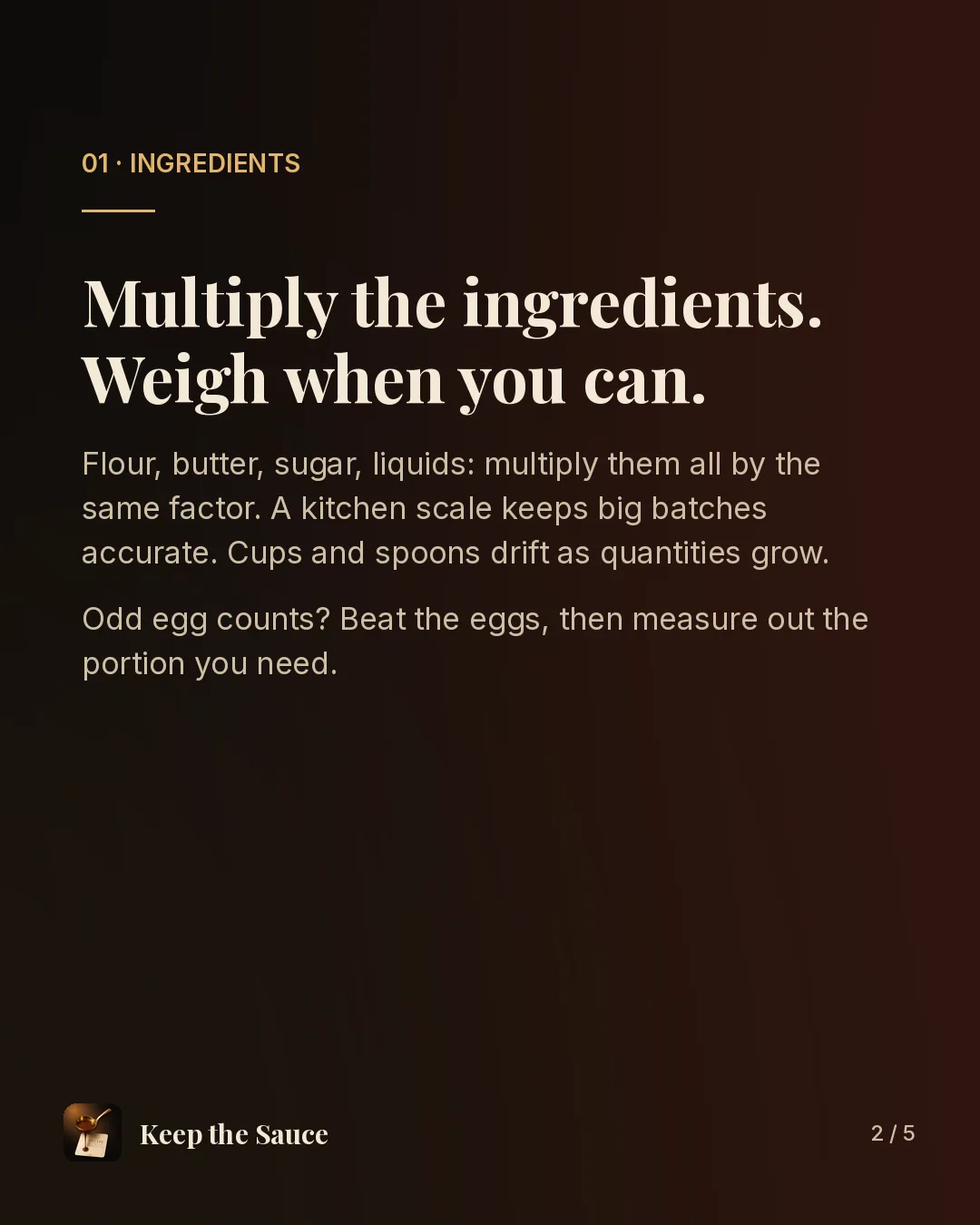
Weigh when you can. Cups and spoons are fine for a single batch, but small errors add up as quantities grow. A scoop of flour can vary by 20% or more depending on how it’s packed, and tripling a heavy cup triples the mistake. A kitchen scale keeps flour, sugar, butter and even liquids accurate at any size.
A few practical tips:
- Odd egg counts: need 1½ eggs? Beat two eggs together, then weigh or measure out the portion you need (a large egg is about 50 g without the shell).
- Leavening: baking soda and baking powder scale with the recipe, so measure carefully, since a little extra shows up as a bitter or metallic taste.
- Convert awkward amounts: 3 tablespoons is easier to measure than 0.1875 cups. 1 cup = 16 tablespoons, and 1 tablespoon = 3 teaspoons.
2. Seasoning: start a little under, then taste
Salt, chili, cayenne, garlic and other bold spices are the exception to straight multiplication. In a big pot they can come across stronger than expected, and there’s less evaporation per serving, so flavors concentrate differently than in a small batch.

The fix is simple: add roughly three-quarters of the multiplied amount to start, then taste near the end and adjust. You can always add more salt; you can’t take it out. This matters most for soups, stews, sauces, chili and brines. For baking, where salt also affects texture and rise, scale it normally but be precise.
3. Time and pans: depth matters, not amount
Cooking time depends on how deep or thick the food is, not how much of it there is. Double a casserole into the same dish and it gets twice as deep, so the outside overcooks long before the center is done.
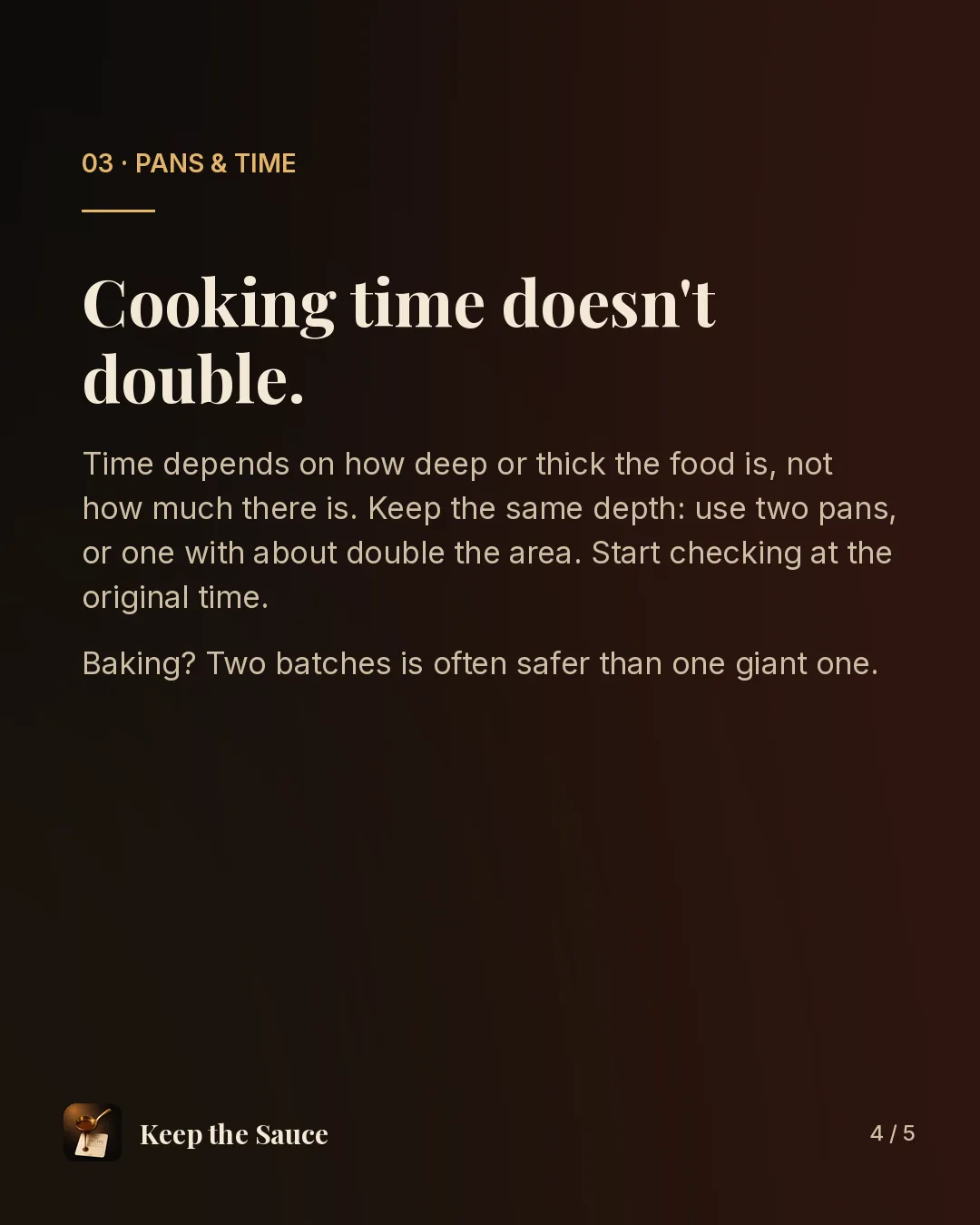
- Keep the same depth. Use two pans, or one pan with about double the area. A 9×13-inch pan (117 sq in) is roughly double an 8×8 (64 sq in).
- Start checking at the original time. If the depth is the same, the timing will be close. Add a few minutes at a time and use a thermometer or toothpick rather than the clock.
- Keep the oven temperature the same. Don’t crank the heat to make up for a bigger batch.
- For baking, two batches often beats one giant one. Cakes, breads and cookies depend on even heat and the right pan size. Two normal batches are usually safer than one enormous one.
- On the stove, give it room. Browning meat or vegetables in a crowded pan steams them instead. Work in batches and let the pan come back up to heat.
A quick worked example
Say Grandma’s chili serves 4 and you’re feeding 10. Your factor is 10 ÷ 4 = 2.5.
| Ingredient | Original (serves 4) | Scaled × 2.5 |
|---|---|---|
| Ground beef | 1 lb | 2½ lb |
| Kidney beans | 1 can (15 oz) | 2½ cans (or 37 oz) |
| Crushed tomatoes | 28 oz | 70 oz |
| Chili powder | 2 tbsp | 5 tbsp, so start with about 3¾ tbsp |
| Salt | 1 tsp | 2½ tsp, so start with about 2 tsp |
Brown the beef in batches so it actually browns, use a pot wide enough that the chili isn’t much deeper than usual, and simmer for the original time before tasting. Then add the rest of the salt and chili powder only if it needs it.
Let the app do the math
We built Keep the Sauce to keep our family’s recipes in one place, and scaling was one of the first things we wanted it to handle. Open any saved recipe, set the servings you need, and every ingredient adjusts in one tap, so Grandma’s recipe feeds four or forty without a calculator on the counter. It’s on iPhone & Android: keepthesauce.com.
FAQ
Can I just double every ingredient? For most ingredients, yes. Multiply everything by the same factor. The exceptions are salt and strong spices (start a little under and taste) and cooking time, which depends on depth rather than amount.
Does cooking time double when I double a recipe? No. If you keep the food at the same depth by using two pans or a larger pan, the time stays close to the original. Start checking at the original time.
Is it better to double a cake or make two batches? Two batches is usually safer. Mixing and baking a giant batch can change texture and rise, and very deep pans bake unevenly.
How do I halve a recipe with one egg? Beat the egg, then use half by weight (about 25 g) or about 2 tablespoons.
Should I use a bigger pan or two pans? Either works as long as the food stays the same depth. Two pans of the original size are the easiest way to keep timing predictable.